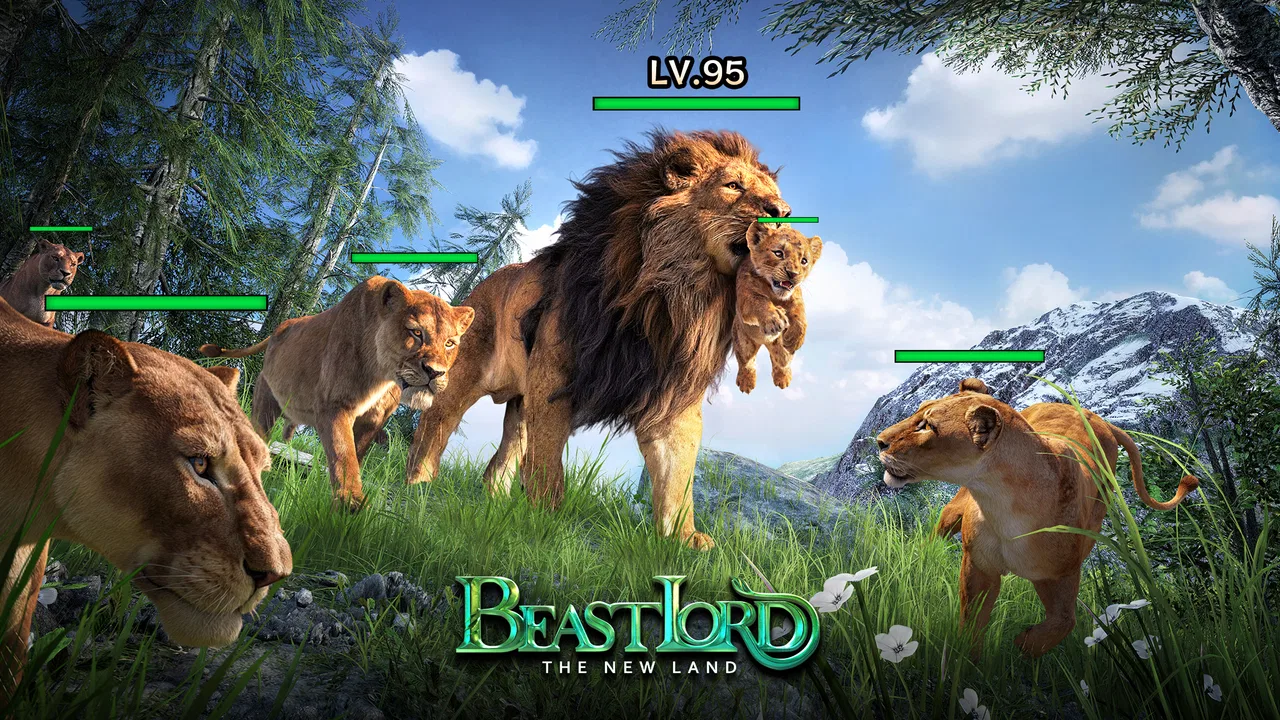
Beast Lord: The New Land
- 4.6
- Rating
- 10.00M
- Installs
- Free
- Price

 Analysis by App-foxy
My first impression of Beast Lord: The New Land was that it wants to make animal survival feel like a long-term strategy project rather than a quick battle game. The idea is simple to understand: you lead a growing animal territory, make decisions about its development, and prepare for conflict in a world where the struggle never really stops. After spending time with it, I found the appeal is less about one dramatic fight and more about building a routine that gradually makes your territory stronger.
This is a free strategy game from StarFortune, with a Teen content rating and support for devices running Android 6.0 or later. Its store presence is already substantial, with a 4.6 average from roughly 66 thousand ratings and more than 10 million installs. Those figures suggest it has reached a broad audience, but they do not change the central question: will its steady, management-focused pace suit you?
My honest answer is yes if you enjoy checking progress, improving a base, organizing a roster, and making several small decisions before committing to a larger move. If you want an immediately intense action game, this is probably not the best match. The important thing is to understand that the first meaningful success comes from learning the rhythm of the territory, not from rushing into every available battle.
You May Also Like

 Blood Strike: 2.5 Anniversary
Blood Strike’s Loadouts Turn Every Drop Into a Tactical Gamble
A close look at Blood Strike’s custom loadouts: how fast access to signature weapons reshapes its battle royale rhythm, rewards preparation, and narrows the gap between fights.

 Pandora - Music & Podcasts
Pandora’s Music Is Easy to Start, but Harder to Recover
Pandora’s strength is its low-effort path from a seed to a station. Its weak spot is how much confidence it asks you to place in connection, setup, and quiet recovery.

 8 Ball Pool
 Is Built on Rivalries, Rematches, and Routine
A close look at the rivalries, rematches, shared routines, and unanswered safety questions that turn a quick pool match into a persistent mobile community.

 Samsung Music
’s Quiet Strength Is Playing What You Already Own
Its reach comes less from spectacle than from dependable access to a personal library. That simplicity is both the app’s strongest retention engine and its ceiling.

 AccuWeather: Weather Radar
AccuWeather Review: A Quick, Clear Forecast for Everyday Decisions
For everyday plans, the best forecast is the one you can understand quickly. AccuWeather makes rain timing, radar, and local conditions easy to act on, with a few trade-offs.

 Hill Climb Racing
Why Hill Climb Racing Still Turns Crashes Into One More Run
A tiny car, a bumpy hill and one more upgrade: Hill Climb Racing keeps resurfacing because its simple chaos makes every near-miss feel personal.
More From Our News Desk



What to expect when you enter the animal territory
The game presents itself as an animal-themed strategy experience, but the animals are not merely decoration. They give the setting its identity and make the usual cycle of expansion, preparation, and conflict feel different from a conventional human kingdom game. You are still thinking about resources, development, units, and timing, yet the presentation encourages you to see the map as a living environment rather than just a collection of targets.
That distinction matters because the game is built around gradual progress. You will spend time improving your position, watching timers or requirements, and deciding which development step deserves attention first. The most satisfying moments are not always spectacular. Often, they come when an earlier improvement finally makes a later action possible, or when a carefully prepared group performs better than an improvised one.
I would describe the pace as persistent rather than frantic. There is enough to do during an active session, but the design also suits short visits. I could open the game, collect what had become available, start the next useful improvement, and leave without feeling that I had wasted the session. Later, I could return with a clearer objective instead of beginning from zero.
That makes it a reasonable companion for people who like mobile strategy games that grow over time. It is less suitable for someone who wants every minute to be filled with direct control. The game asks you to think about what should happen next, then wait for your plan to develop. That waiting is part of the experience, not a temporary obstacle that disappears after the opening.
The animal theme also gives the game a friendlier surface than many war-focused strategy titles, although the conflict itself still shapes much of the decision-making. The Teen rating is worth keeping in mind for families choosing games for younger players. It is not something I would hand to a child without checking whether the strategic conflict and purchase options fit the household’s preferences.
The first minutes are about orientation, not optimization
When I first started, I found it tempting to treat every highlighted action as equally urgent. That is a common mistake. Early guidance is useful for showing the controls and basic flow, but it does not mean every suggested upgrade is the best long-term choice in every situation. I got more from the opening once I slowed down and paid attention to what each action unlocked.
My advice is to follow the initial prompts until the basic loop feels clear, then pause before spending anything simply because a button is visible. Look at the requirements for the next few improvements. If one upgrade supports several upcoming actions, it is usually more valuable than a narrow improvement that solves only the immediate task.
This is one of the first non-obvious lessons in mobile strategy: the cheapest action is not automatically the most efficient action. A small saving at the start can leave you waiting later, while a slightly more deliberate choice may keep several parts of the territory moving together.
How I approached the first setup
For a first-time player, the opening setup is easier if you divide it into three questions. What is currently blocking progress? Which improvement removes that blockage? What will I need immediately after that? Thinking this way prevents the territory from becoming a random collection of upgrades.
I started by identifying the action that opened the broadest path forward, rather than focusing only on visual changes. In a game like this, a building or development option can look attractive while contributing little to the next practical goal. I preferred choices that improved access to more activities, strengthened preparation, or reduced the chance of sitting idle.
Another useful habit is to keep one short-term objective and one medium-term objective in mind. The short-term goal might be completing the next available development step. The medium-term goal could be preparing a stronger force or reaching a new stage of territory growth. Without that second goal, it is easy to spend everything on immediate convenience and then discover that the next important action is still out of reach.
I also recommend checking the game’s menus calmly during the first session. Important information can be distributed across several screens, and tapping through quickly makes the interface feel more complicated than it is. I learned more by opening each available panel, reading the requirements, and returning to the main territory than by trying to memorize everything at once.
The current version is 1.0.117, so the exact presentation may change over time, but the basic advice remains useful: let the opening teach you the structure, then begin making choices based on your own priorities. Do not assume that every glowing prompt represents an emergency.
Finding the first meaningful success
For me, the first real success was not simply completing the tutorial. It was reaching a point where the territory felt self-directed: I knew what I was improving, why I was improving it, and what I planned to do when that step finished. That shift is important because it turns the game from a sequence of instructions into a strategy you are actually managing.
A practical first-session routine is to collect what is ready, inspect the next available improvements, choose one action that supports future progress, and then prepare for the earliest conflict or challenge that fits your current strength. I would not begin by testing the hardest-looking option. A controlled success teaches you more than an avoidable defeat, especially when you are still learning how the game expects you to organize your forces.
Before committing to a battle, I looked at the available information instead of assuming that a larger-looking opponent was automatically worth fighting. Preparation is where the strategic character becomes clear. Your result depends not only on pressing the attack button, but also on whether your earlier development choices left you ready for it.
This approach also makes the game less intimidating. You do not need to understand the whole world immediately. You need to create a small chain of sensible decisions: improve something useful, strengthen your position, choose a manageable objective, and use the result to decide what comes next.
A realistic everyday example would be a short evening session after work or school. I might have only a few minutes, so I would collect completed progress, begin one worthwhile improvement, check whether my current forces are ready for a modest challenge, and stop there. The session still feels productive because it advances a plan rather than encouraging random tapping.
Where new players commonly get confused
The biggest source of confusion is the difference between visible activity and meaningful progress. A busy screen can make it feel as though you should activate every option, but several small actions may be less useful than one carefully chosen development step. I had to remind myself that the game rewards planning over constant movement.
Another point of friction is the relationship between expansion and readiness. It is easy to become interested in the next area or challenge before your current position can support it. When that happens, the game can feel slow, although the real issue is often that development and preparation have fallen out of balance.
I found it helpful to treat every new opportunity as a question rather than an instruction. Does this help my immediate objective? Does it consume something I need for a more important step? Will it make the next session easier, or only make this moment look more active? Those questions prevented several rushed choices.
Players may also wonder whether they need to spend money to enjoy the game. It is free to download and play, but it includes in-app purchases ranging from $0.99 to $99.99 per item. That range means purchase discipline matters. I would approach optional spending as a convenience decision, not as a requirement for understanding the game. First learn the normal progression, then decide whether saving time or gaining extra flexibility is worth the cost to you.
My strongest advice is to avoid buying anything while you are still unsure what the item changes. If you cannot explain how a purchase affects your current plan, wait. A new player gets better value from understanding the development loop than from accelerating a random part of it.
There is also a social expectation common to persistent strategy games: progress can feel more meaningful when you have a reason to return. If you prefer games that are fully contained in one sitting, the long-term structure may feel demanding. On the other hand, if you enjoy maintaining a project and seeing yesterday’s choices influence today’s options, this ongoing format can be rewarding.
How it compares with more familiar strategy games
Compared with a traditional real-time strategy game, this is less about constant unit control and more about building a durable position. You are not usually managing every second of a battlefield in the same way you would on a desktop strategy map. The trade-off is accessibility: I could make progress in short sessions without needing a large uninterrupted block of time.
Compared with a simple puzzle strategy game, it asks for more patience and longer planning. A puzzle usually gives you a clear board and a defined finish. Here, the territory continues to develop, and the best choice can depend on what you expect to do later. That makes the game more involving, but also less immediately tidy.
Compared with a purely casual animal game, the animal setting is only one layer. The strategic decisions are the reason to stay. Someone looking mainly for decoration, collecting, or a relaxed visual experience may find the conflict and progression systems more demanding than expected.
Its strongest advantage over many familiar alternatives is the combination of an approachable theme and a persistent strategy loop. Its main weakness is the same persistence: the game can ask for regular attention without always delivering a dramatic event in return. I enjoyed it more when I accepted that small, well-timed improvements were the reward.
Who should try it, and who should skip it
I would recommend it to players who like planning several steps ahead, checking a developing base, and making progress through repeated short visits. It is especially suitable if you enjoy strategy games but do not always have time for long battles. The animal setting also gives it a distinct personality compared with the usual medieval or science-fiction alternatives.
I would be more cautious recommending it to anyone who dislikes timers, resource decisions, or games that expect you to return regularly. If you want a complete campaign with a clear ending, a premium strategy title may suit you better. If you want direct action with little preparation, an action game will probably be more satisfying.
Players who are sensitive to optional purchases should decide on a personal spending rule before they begin. The free entry point is helpful, but the presence of purchases means it is wise to keep the focus on learning and planning instead of treating every delay as a problem that needs a paid solution.
A practical routine for the next stage
Once the opening is comfortable, I suggest using a simple rotation. First, review what has completed. Second, choose the improvement that supports your current objective. Third, inspect your readiness before starting a conflict. Finally, leave the game with one action already moving toward the next visit.
The third step is the one I found most valuable. Many players focus on what they can start, but experienced play also depends on what they should postpone. If a challenge would consume the resources or strength needed for a more useful development step, waiting is not failure. It is a strategic choice.
I also kept a mental note of which actions produced a lasting benefit and which merely solved a temporary shortage. That distinction helped me avoid repeating the same weak cycle. When a choice improved several future options, I treated it as a priority. When it only made one screen look better, I waited until the broader plan supported it.
The game becomes more enjoyable when you stop measuring each session by how many buttons you pressed. Measure it by whether you improved your position, clarified your next objective, or learned enough from a challenge to make the next decision better. That is a more reliable way to build momentum.
My final recommendation
Beast Lord: The New Land is a patient, persistent strategy game with an animal-world identity and a clear focus on gradual territory development. I liked that it gave short sessions a purpose while still leaving room for longer planning. The first meaningful success comes when you stop following prompts mechanically and begin connecting upgrades, preparation, and challenges into one plan.
It is not the right choice for every mobile player. The ongoing pace can feel slow, and the optional purchase range deserves careful handling. Still, the free starting point makes it easy to test whether the rhythm fits you. I would install it if you enjoy strategy that grows in the background and rewards returning with a plan.
My best starting advice is simple: follow the early guidance, inspect requirements before spending, choose improvements that open several future options, and take your first serious challenge only when your territory is ready. If that measured progress sounds satisfying rather than restrictive, StarFortune’s game has enough structure to become a dependable daily strategy habit.
FAQs for Beast Lord: The New Land
01What is Beast Lord: The New Land about?
Beast Lord: The New Land is a strategy and kingdom-building game set in a wild, post-apocalyptic environment. You develop a territory, gather resources, construct and upgrade facilities, recruit powerful beasts, and expand your influence. Survival depends on balancing construction, research, troop development, and alliances while dealing with rival players and the dangers surrounding your growing settlement.
02Is Beast Lord: The New Land free to download and play?
The game can generally be downloaded and started for free, but it includes optional in-app purchases. These purchases may provide resources, speed up construction, unlock useful items, or offer progression bundles. You can make progress without spending money, although free players may need more patience and regular activity, especially when competing against players who invest heavily in premium packs.
03Does Beast Lord: The New Land require an internet connection?
Yes, Beast Lord: The New Land is designed as an online multiplayer experience and normally requires a stable internet connection. Your progress, events, alliances, rankings, and interactions with other players depend on communication with the game servers. Because of this, it is not a suitable choice for completely offline play, and connection problems may interrupt battles or loading.
04What can players do in Beast Lord: The New Land?
Players can build and upgrade a settlement, collect materials, research technologies, hatch or develop beasts, train units, and improve commanders or other important characters. The game also includes exploration, territory expansion, missions, events, and competitive activities. Joining an active alliance is particularly useful because cooperation can provide assistance, shared objectives, and additional rewards during larger conflicts.
05Is Beast Lord: The New Land suitable for casual players?
It can be enjoyed casually, especially during the early stages when construction, missions, and progression feel straightforward. However, the game becomes more demanding as timers grow longer and competition between alliances increases. Players who log in regularly will usually progress more efficiently, collect more rewards, and remain competitive. Those seeking a short offline game may find its online management style less suitable.
Pros
- Engaging city-building and territory expansion mechanics
- Large variety of beasts to collect
- upgrade
- and deploy
- Alliance features encourage cooperation with other players
- Detailed fantasy visuals bring the jungle world to life
- Regular events provide additional goals and rewards
Cons
- Progress can feel slow without spending premium currency
- Many upgrades require long waiting times
- Frequent battles may become repetitive over time
- Competitive rankings favor highly active or paying players
- Requires a stable internet connection to play

Beast Lord: The New Land
Gallery